
Looking Back: what happened in 1975
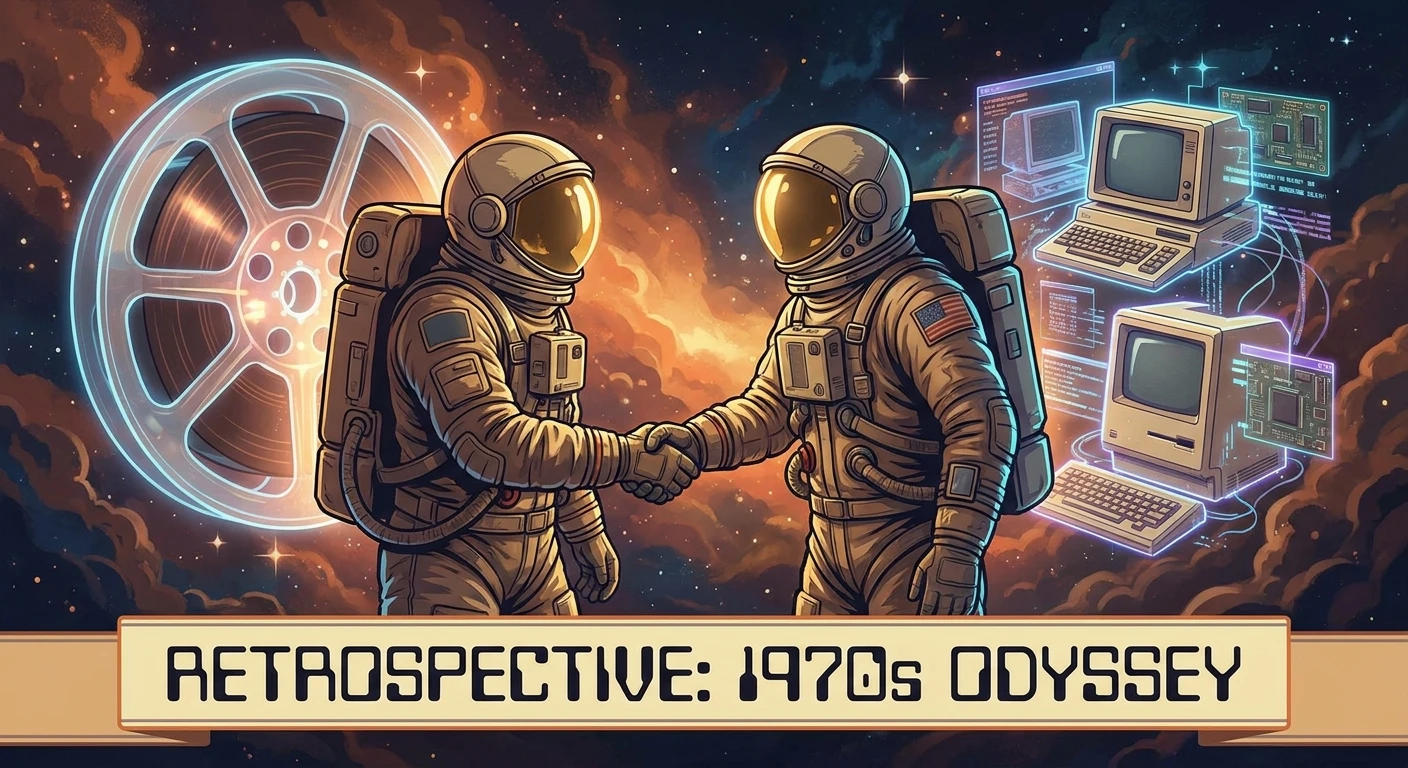
If you are trying to piece together exactly what happened in 1975, you are looking at a massive twelve-month stretch that fundamentally rewired global politics, technology, and pop culture. I remember my grandfather, who lived right in the heart of Kyiv at the time, telling me a vivid story about that summer. He recalled how the distant, crackling audio of the Apollo-Soyuz space mission broadcast over their old radio brought a sudden, surreal sense of global unity to our neighborhood. It cut right through the heavy Cold War tension of the era. People stood in their kitchens, utterly fascinated, listening to an American astronaut and a Soviet cosmonaut shaking hands in orbit. It was a wild, historic moment that felt like a sudden breath of fresh air.
That specific year didn’t just cap off long, exhausting geopolitical conflicts; it actively laid the physical and cultural foundation for the digital lifestyle we take completely for granted right now. Whether you are typing on a modern laptop or sitting down to watch a massive blockbuster movie franchise, you are directly interacting with echoes of that exact time. We sit here in 2026, and I still see the ripples of those mid-seventies breakthroughs absolutely everywhere. From the chaotic, final evacuation flights ending the Vietnam era to a quiet garage in New Mexico where software first became a retail product, 1975 packed a serious historical punch. Let me walk you through the major milestones, tech shifts, and cultural moments that defined this incredibly pivotal time.
The Core Events That Redefined the Decade
Understanding the sheer scale of the events from this year gives you a brilliant masterclass in modern history. The sheer volume of societal shifts packed into these twelve months is staggering. I put together a quick breakdown of the heavy hitters so you can see exactly how diverse these global milestones were.
| Major Event | Core Category | Long-term Global Impact |
|---|---|---|
| Fall of Saigon | Geopolitics | Effectively ended the prolonged Vietnam conflict, dramatically reshaping foreign policy. |
| Apollo-Soyuz Mission | Space Exploration | Marked the first international partnership in space, paving the way for the ISS. |
| Founding of Microsoft | Technology | Kickstarted the entire personal computing software industry we rely on today. |
| Helsinki Accords | International Law | Established crucial human rights standards and eased Cold War diplomatic tensions. |
Grasping these events helps you instantly make sense of our current technological and political landscape. Take the tech space as a prime example. Before this specific year, computers were massive, room-sized monoliths owned exclusively by massive governments or giant corporations. The idea of a normal person owning one was practically science fiction. Yet, by the end of the year, the exact seeds of the personal computer were firmly planted. A second massive example is the shifting global economy. The mid-70s inflation spikes and energy crises forced central banks to learn incredibly hard lessons about managing global supply chains—lessons that financial experts still debate heavily right now.
Here are the three main pillars of change you need to remember:
- The geopolitical map shifted permanently as long-standing, devastating international conflicts finally burned out, forcing nations to rebuild.
- Computing broke completely out of corporate laboratories, teasing a massive consumer electronics revolution that would change how humans communicate.
- The global entertainment industry finally figured out the highly profitable formula for the summer blockbuster, fundamentally changing movie funding and pop culture forever.
Origins of the Microcomputer Revolution
The story of our modern screens basically starts right here. In January, the Altair 8800 appeared on the cover of Popular Electronics magazine. It was a metal box with switches and blinking lights, but it completely captivated computer hobbyists. Two young guys named Bill Gates and Paul Allen saw that magazine, realized the hardware needed an operating language, and frantically wrote a version of BASIC for it. They moved to Albuquerque, New Mexico, to be near the manufacturer, and officially started a little company they called “Micro-Soft.” They didn’t have sleek offices or endless venture capital; they had punched paper tape and a shared belief that computing belonged in everyday homes. This single spark ignited the massive software industry.
Evolution of Cold War Diplomacy
Diplomatically, the world took a massive step back from the brink of nuclear anxiety. The Helsinki Accords were signed by 35 nations, including the United States and the Soviet Union. This agreement basically recognized the post-World War II borders in Europe but, more importantly, included massive commitments to human rights. It gave political dissidents behind the Iron Curtain a legal framework to demand better treatment. Simultaneously, the historic Apollo-Soyuz Test Project put an American Apollo module and a Soviet Soyuz capsule together in orbit. Commander Thomas Stafford and Cosmonaut Alexei Leonov shook hands through the hatch, proving that rival superpowers could successfully cooperate on massive engineering challenges.
Modern State of 1975’s Cultural Milestones
Culturally, the year shifted into high gear and never looked back. Steven Spielberg unleashed a mechanical shark on theatergoers with Jaws. It became the highest-grossing film of its time, completely inventing the concept of the summer blockbuster. Suddenly, studios realized they could make massive amounts of money by releasing high-concept action movies in the middle of summer. Over in the music world, the British rock band Queen released “Bohemian Rhapsody.” Music executives told them a six-minute operatic rock song would never get radio play, but it completely shattered conventional radio formats and remains one of the most streamed classic rock songs globally. The pop culture rules were completely rewritten.
The Engineering Behind Apollo-Soyuz
The technical hurdles required to make the Apollo-Soyuz handshake happen were absolutely staggering. American and Soviet spacecraft were entirely incompatible. They operated at completely different atmospheric pressures, used different docking mechanisms, and even ran on different electrical voltages. To fix this, engineers had to quickly design a custom airlock called the Docking Module. This tubular corridor allowed the crews to equalize pressure safely so nobody got the bends when moving between ships. It was a masterclass in compromise engineering, forcing intense collaboration between fiercely competitive aerospace teams.
Digital Architecture of Early PCs
When we look at the internal brains of the era’s technology, everything revolved around the newly minted microprocessors. The Altair 8800 utilized the Intel 8080 CPU. By modern standards, this chip was incredibly primitive, but it was revolutionary because it was affordable and small enough to fit on a desktop. Hobbyists had to input code manually by flipping physical toggle switches on the front panel just to make the lights blink in a specific pattern. Memory was incredibly scarce; the earliest Altair machines shipped with a hilariously tiny amount of RAM.
- The Apollo and Soyuz spacecraft required a custom-built docking module to safely resolve a massive 5 PSI versus 14.7 PSI atmospheric mismatch.
- The revolutionary Altair 8800 originally shipped to consumers with a mere 256 bytes of RAM, barely enough to hold a few lines of code.
- The very first digital camera was invented at Eastman Kodak by Steve Sasson this same year; it weighed 8 pounds, used a cassette tape for storage, and captured black-and-white 0.01 megapixel images.
- The Intel 8080 processor, which powered the microcomputer boom, ran at a blazing speed of just 2 MHz.
Step 1: Watch the Original Summer Blockbuster
If you want to feel the energy of this era, start by putting on Jaws. Pay close attention to how Spielberg builds intense suspense without actually showing the mechanical shark for the first half of the film. This wasn’t a brilliant artistic choice initially; the mechanical shark kept malfunctioning, forcing them to use the camera as the shark’s point of view. It accidentally created a cinematic masterpiece.
Step 2: Listen to “A Night at the Opera”
Fire up Queen’s iconic 1975 album and skip straight to “Bohemian Rhapsody.” Listen to the incredibly dense vocal layering. They literally wore the magnetic recording tape thin, passing it over the recording heads hundreds of times to dub all the massive choir sections. It is a stunning piece of analog audio engineering.
Step 3: Study the Fall of Saigon
Take some time to read historical accounts or watch archived news footage from April 30. The images of helicopters airlifting evacuees from rooftops visually encapsulate the tragic, chaotic end to a two-decade-long conflict. It is a sobering but essential piece of understanding modern geopolitics.
Step 4: Explore the First Digital Camera Patents
Look up Steve Sasson’s original Kodak prototype. It looks like a bizarre toaster strapped to a circuit board. Understanding how long it took for this bulky prototype to eventually morph into the sleek smartphone cameras we use in 2026 shows you the slow, methodical pace of actual hardware innovation.
Step 5: Review the Helsinki Accords
Pull up a summary of the Helsinki Final Act. Read exactly how the diplomatic agreements were structured. It is fascinating to see how combining human rights demands with border agreements fundamentally changed the strategy of Cold War diplomacy, empowering civil rights groups across Eastern Europe.
Step 6: Trace the Roots of Microsoft
Look into the early days of Bill Gates and Paul Allen in Albuquerque. Before Windows, before the massive Seattle campuses, they were just two young guys selling BASIC software to hobbyists. It demystifies the massive tech giants and reminds you that every massive monopoly starts as a scrappy, uncertain startup.
Step 7: Watch Apollo-Soyuz Archival Footage
Find the original color broadcasts of the space handshake. Seeing the bulky, retro spacesuits and hearing the clunky, delayed audio transmissions highlights exactly how brave these early space explorers were. It perfectly captures a rare moment of pure optimism in a heavily divided world.
Myths vs. Historical Reality
Myth: Microsoft started in a high-tech Silicon Valley laboratory alongside Apple.
Reality: Bill Gates and Paul Allen actually founded the company in Albuquerque, New Mexico. They relocated there simply to be physically close to the company manufacturing the Altair 8800 computer. They didn’t move the company to Washington State until years later.
Myth: The Vietnam War ended peacefully with a formal, negotiated treaty in 1975.
Reality: The conflict effectively ended through rapid military action, culminating in the chaotic Fall of Saigon on April 30. North Vietnamese forces aggressively captured the city, leading to frantic, dangerous helicopter evacuations of remaining personnel from embassy rooftops.
Myth: Steven Spielberg’s Jaws was a perfectly planned, flawless Hollywood production.
Reality: The production was a notorious nightmare. The mechanical shark constantly sank or broke down in the saltwater. Spielberg was forced to use John Williams’ iconic musical score and underwater camera angles to imply the shark’s presence, creating intense suspense purely out of mechanical desperation.
Frequently Asked Questions & Final Thoughts
Who ended the Vietnam War?
The war concluded when North Vietnamese forces captured Saigon, the capital of South Vietnam, forcing a final surrender and ending the decades-long conflict.
When was Microsoft exactly founded?
Bill Gates and Paul Allen officially formed the company on April 4, originally focusing entirely on developing software for early microcomputers.
What was the biggest movie of the year?
Jaws completely dominated the box office, terrifying beachgoers and essentially inventing the modern Hollywood summer blockbuster release strategy.
Who won the Super Bowl during this year?
The Pittsburgh Steelers defeated the Minnesota Vikings 16-6 in Super Bowl IX, heavily relying on their legendary “Steel Curtain” defense.
What exactly was the Apollo-Soyuz mission?
It was the very first joint space mission between the United States and the Soviet Union, resulting in a historic handshake in Earth’s orbit.
Who became the leader of Spain?
Following the death of dictator Francisco Franco in November, Juan Carlos I was proclaimed King, steering the country toward a massive democratic transition.
What is the Helsinki Final Act?
It was a massive diplomatic declaration signed by 35 countries to improve relations between the Communist bloc and the West, heavily emphasizing human rights.
Looking back, the pure density of historical, technological, and cultural shifts makes this era absolutely fascinating. It literally bridged the gap between the analog past and our hyper-connected present. If you want to keep exploring the massive milestones that built our modern reality, subscribe to our weekly history newsletter for more direct, unfiltered stories from the past!
Leave a Reply