
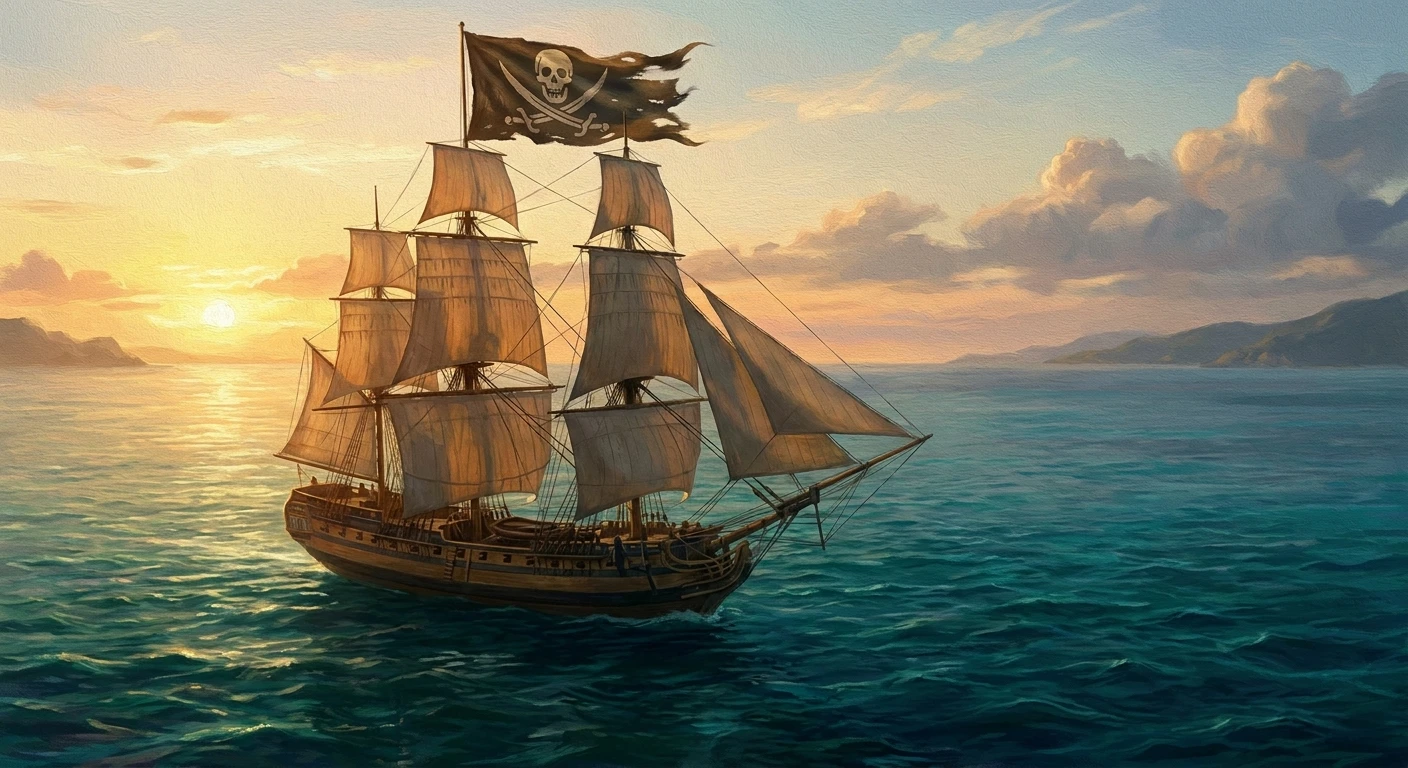
The Legend of Calico Jack: The Pirate Who Designed the Jolly Roger
Whenever someone mentions Calico Jack, the immediate image that flashes into the mind is the iconic black flag featuring a stark white skull over two crossed swords. John Rackham, famously remembered by his colorful nickname, remains one of the most widely recognized figures from the Golden Age of Piracy. You might assume he was the most terrifying captain to ever sail the Caribbean, but the historical reality is far more nuanced, fascinating, and dramatic. The story of this particular buccaneer gives us a direct window into the socio-political climate of the early 18th century, revealing how a relatively minor pirate cemented a legacy that outlasted the most fearsome warlords of the seas.
His nickname was derived from his flamboyant taste in clothing, specifically the brightly colored Indian calico fabric he wore, which set him apart from the rugged, salt-stained aesthetic of his contemporaries. Beyond his fashion sense, his true fame stems from two incredible factors: his association with two of history’s most famous female pirates, Anne Bonny and Mary Read, and his brilliant use of psychological branding through his flag design. Understanding his life requires stripping away centuries of Hollywood dramatization and looking closely at the brief, explosive timeline of a man who navigated the collapsing pirate republic of Nassau just as the British Empire began to crack down on maritime outlaws.
Read also: History's Most Famous Pirates: The Complete Guide; The Legacy of george webb (actor).
The Core Strategy of a Golden Age Pirate
To truly grasp the impact of Calico Jack on maritime history, we have to look at the tactics he employed during his brief captaincy. Unlike Blackbeard or Bartholomew Roberts, who commanded massive fleets and terrorized heavily fortified naval vessels, Rackham was a pirate of opportunity. He specialized in coastal raids, capturing small merchant sloops, fishing vessels, and transport boats that were lightly defended. His crew rarely engaged in massive artillery battles. Instead, they relied on speed, surprise, and sheer intimidation.
His most brilliant asset was undoubtedly his crew dynamic and branding strategy. By bringing Anne Bonny and Mary Read aboard, he inadvertently created a crew that fought with unmatched ferocity. The women were known to be fiercely loyal, highly skilled in combat, and utterly ruthless when boarding enemy vessels. This unusual crew composition, paired with a customized terrifying flag, gave his relatively small ship a massive psychological edge over local merchants.
Here is a breakdown of how his strategies compared to the standard pirate operations of the era:
| Aspect of Piracy | Calico Jack’s Approach | Standard Piracy Strategy |
|---|---|---|
| Ship Selection | Small, fast, shallow-draft sloops for quick getaways. | Large galleons and heavily armed frigates. |
| Target Profile | Local merchants, fishing boats, and coastal traders. | Transatlantic treasure fleets and slave ships. |
| Intimidation Tactics | Custom skull and crossed swords flag to force early surrender. | Overwhelming cannon fire and sheer crew numbers. |
Three primary elements defined his short but legendary career on the high seas:
- Psychological Branding: He realized that a terrifying flag could win a battle before a single shot was fired, leading to the creation of the skull and crossed cutlasses design.
- Unconventional Crew Selection: Defying the strict maritime superstitions of the time, he openly sailed with women who became some of the most fearsome fighters in his crew.
- Political Manipulation: He initially accepted the King’s Pardon in 1719, showing a pragmatic approach to survival, only to break it when domestic disputes pushed him back to piracy.
Origins: Early Days as a Quartermaster
The early life of John Rackham remains shrouded in mystery, with historical records only picking up his trail around 1718. At that time, he was serving as the quartermaster aboard the brigantine Ranger, under the command of the notorious Captain Charles Vane. In the pirate hierarchy, the quartermaster was heavily respected, acting as a representative of the crew and a counterbalance to the captain’s authority. Vane was known for his cruelty and his stubborn refusal to accept the King’s Pardon offered by Bahamas Governor Woodes Rogers. During a confrontation with a powerful French warship, Vane chose to retreat rather than fight. Rackham, seeing an opportunity, rallied the dissatisfied crew. He argued that the French ship was a prime target for plunder. The crew held a vote, branded Vane a coward, stripped him of his captaincy, and elected Rackham as their new leader. This bloodless mutiny marked the official beginning of his command.
Evolution: The Pardon and the Return to Piracy
After taking control of the Ranger, Calico Jack enjoyed a brief stint of successful coastal raiding. However, realizing the growing strength of the British anti-piracy campaign, he sailed into Nassau in 1719 and accepted the Royal Pardon from Governor Rogers. It was during this period on land that he met Anne Bonny, who was married to a minor pirate informant named James Bonny. The two began a passionate affair. When James Bonny discovered the infidelity, he dragged Anne before Governor Rogers, demanding she be flogged for adultery. Rackham offered to buy her divorce—a common, albeit unrecorded, practice—but the offer was rejected. Left with no legal options, Rackham and Bonny voided their pardon, stole a fast twelve-gun sloop named the William, and fled Nassau under the cover of darkness. This bold theft cemented their status as highly wanted fugitives and kicked off their final, frantic months of piracy.
Modern State: Pop Culture and Enduring Legacy
Despite being captured and executed in 1720, the cultural footprint of Calico Jack has only grown over the centuries. Modern media has heavily romanticized his life. In the acclaimed television series Black Sails, his character is portrayed as a cunning, deeply ambitious strategist who is obsessed with his historical legacy. Video games like Assassin’s Creed IV: Black Flag feature him prominently as an erratic but charismatic ally. Beyond direct portrayals, his customized Jolly Roger is now the universal symbol for piracy worldwide. It adorns everything from children’s toys to professional sports team logos. While his actual haul of stolen treasure was remarkably small compared to his peers, his contribution to the visual aesthetic and mythological lore of the pirate era remains absolutely unmatched.
The Mechanics of Golden Age Piracy
To fully appreciate how a pirate with a small crew and limited firepower managed to cause such a disruption across the Caribbean, we need to look at the maritime technology and psychological warfare of the era. The 1700s were a time of slow communication, meaning that visual signals and ship maneuverability were the ultimate deciders of life and death on the water.
The Anatomy of an 18th-Century Sloop
Rackham’s stolen vessel, the William, was a sloop. In naval architecture, a sloop of this era was a relatively small, single-masted sailing ship configured with a fore-and-aft rig. While naval warships relied on massive square-rigged sails designed for long ocean crossings, the sloop was designed for the chaotic, reef-filled waters of the Caribbean. The sloop allowed pirates to sail much closer to the wind, meaning they could outmaneuver cumbersome British naval vessels trying to chase them. Furthermore, sloops had a very shallow draft. This meant the bottom of the ship did not sit deep in the water, allowing pirates to hide in shallow coves, river mouths, and mangrove swamps where heavy warships simply could not follow without running aground.
Psychological Warfare and the Jolly Roger
The iconic flag was not just a decoration; it was a highly calculated weapon of psychological warfare. Before standardizing the skull and crossbones, pirates often flew red flags, signifying that no quarter (no mercy) would be given. The black flag was actually a slightly better alternative for merchants, signaling that if they surrendered their cargo without a fight, the crew would be spared. Rackham’s specific addition of the skull and crossed cutlasses communicated a clear, localized threat: surrender immediately, or face violent boarding.
- Visibility: High-contrast white on black was easily identifiable through an 18th-century spyglass from miles away.
- Efficiency: Fore-and-aft rigging allowed the sloop to close the distance before the merchant ship could effectively change course.
- Careening: Sloops could easily be tipped on their sides on secluded beaches to clean the hull of barnacles, maintaining their crucial speed advantage.
- Draft depth: Averaging only 8 to 12 feet, allowing escape over treacherous coral reefs.
7-Day Historical Pirate Tour Itinerary
If you want to retrace the actual historical footsteps of Calico Jack and his legendary crew, the Caribbean still holds the remnants of their brief but explosive careers. Here is a factual, step-by-step 7-day itinerary for exploring the true sites of his pirate life.
Day 1: Arrival in Nassau, Bahamas
Start your journey on the island of New Providence. Nassau was once the thriving heart of the Pirate Republic, a lawless sanctuary where thousands of pirates drank, gambled, and sold stolen goods. Today, you can walk the historic harbor areas where Rackham first accepted the King’s Pardon.
Day 2: Exploring the Pirate Republic’s Ruins
Spend your second day investigating the historical forts around Nassau, such as Fort Charlotte and Fort Montagu. While built slightly after his time, they represent the massive British military push that Governor Woodes Rogers initiated to drive out captains like Rackham and Vane. Visit the Pirates of Nassau Museum for an accurate depiction of life in the shantytowns.
Day 3: Sailing to Harbour Island
Take a ferry or charter a boat toward Harbour Island and the surrounding cays. These shallow, reef-protected waters are exactly where sloops like the William would hide to scrape their hulls or ambush passing trade vessels. It gives you a true sense of the navigational hazards of the Bahamian waters.
Day 4: Crossing the Caribbean to Jamaica
Fly or sail down to Jamaica, the site of Rackham’s final days. His crew spent late 1720 terrorizing the northern and western coasts of the island, capturing small fishing boats and local merchant vessels. The lush coastline provided ample hiding spots for his small ship.
Day 5: Negril Bay – The Final Stand
Visit Negril Bay on the western tip of Jamaica. In late October 1720, pirate hunter Captain Jonathan Barnet caught the crew of the William anchored here. The crew was reportedly drunk after a night of celebrating a recent capture. When Barnet attacked, Rackham and most of the men hid in the hold, leaving Anne Bonny and Mary Read to fiercely fight the attackers on the deck alone.
Day 6: The Trial Sites in Spanish Town
Travel to Spanish Town, the former capital of Jamaica. This is where the infamous trial took place in November 1720. The courthouse records detail how the men were swiftly found guilty of piracy and sentenced to hang. It was here that Anne Bonny reportedly delivered her legendary final words to Rackham: “If you had fought like a man, you need not have been hang’d like a dog.”
Day 7: Deadman’s Cay and Port Royal
Conclude your historical journey near Port Royal. Following his execution, Rackham’s body was gibbeted—hung in chains—on a tiny islet at the entrance to Port Royal as a gruesome warning to all passing sailors. The islet is still known today as Rackham’s Cay.
Myth: The Most Feared Pirate in the Caribbean
Myth: Calico Jack was a highly successful, terrifying pirate who amassed massive amounts of treasure and commanded a massive fleet.
Reality: He was actually a small-time pirate operator. His prizes were mostly minor fishing boats and local traders, not massive Spanish treasure galleons. He is famous for his branding and his crew, not his wealth.
Myth: He invented the skull and crossbones flag entirely by himself.
Reality: Variants of the skull and crossbones were already in use by other captains. His specific genius was popularizing the skull paired with crossed cutlasses, creating the definitive version we recognize today.
Myth: He died fighting heroically on the deck of his ship.
Reality: Historical trial documents confirm he was completely intoxicated when attacked and hid below deck, surrendering almost immediately while the women fought.
Frequently Asked Questions
What was Calico Jack’s real name?
His given birth name was John Rackham. The exact date of his birth is unverified, but he is believed to have been born in England around December 1682.
Why was he called Calico Jack?
He earned the nickname because he regularly wore flamboyant, brightly colored clothing made from Indian calico cloth, which was considered quite eccentric for a pirate.
Did he design the skull and crossbones?
He specifically designed the variant featuring a white skull over two crossed cutlass swords on a black background, which became the standard pop-culture Jolly Roger.
Who were the women on his ship?
Anne Bonny and Mary Read. Both women dressed in men’s clothing during battle, fought aggressively, and are among the only documented female pirates of the Golden Age.
How did his pirate career end?
He was ambushed by pirate hunter Jonathan Barnet in October 1720 at Negril Bay, Jamaica, captured, put on trial, and hanged.
Was he a successful pirate?
In terms of financial gain, no. His captures were minor. However, in terms of historical legacy and cultural impact, he is arguably the most successful pirate in history.
Where is his treasure today?
Because he largely stole perishable goods, basic supplies, and small amounts of coin to keep his crew fed, there is no massive buried treasure associated with him.
The history of Calico Jack proves that sometimes an enduring legacy is built not on massive wealth or unyielding terror, but on a sharp aesthetic and an unforgettable crew dynamic. His brief stint as a captain changed the visual language of rebellion forever. If you are captivated by maritime history, consider planning a visit to the historic sites of Nassau and Jamaica to see the waters that shaped the Golden Age of Piracy firsthand.
Leave a Reply