
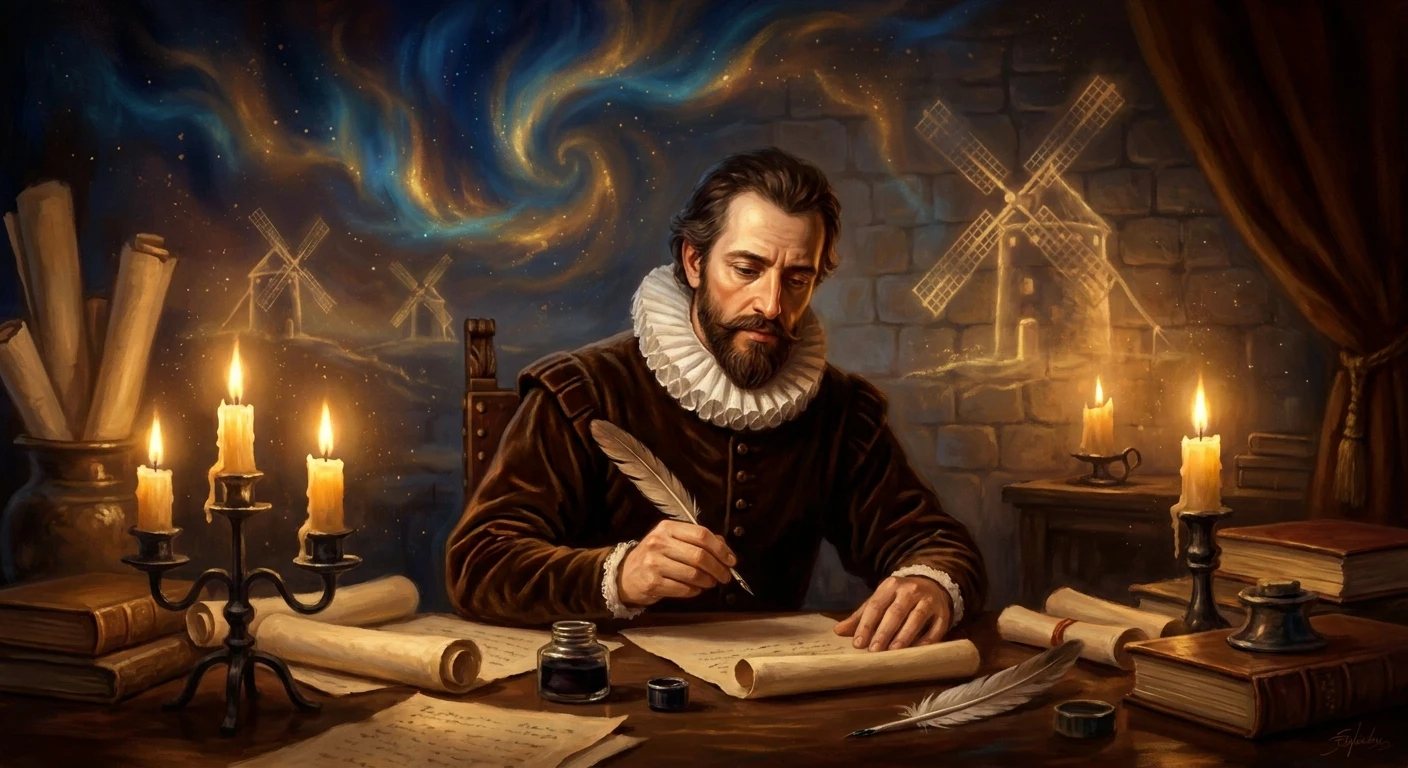
Why Miguel de Cervantes Still Dictates Modern Storytelling
When you start reading almost any contemporary piece of fiction, you are experiencing the direct literary descendant of Miguel de Cervantes. You might think you are just holding a fresh bestseller, but the very DNA of that narrative structure traces straight back to a Spanish writer who completely rewired how humans tell stories. Before his time, European literature was largely dominated by epic poetry, rigid historical chronicles, and highly idealized chivalric romances featuring flawless knights fighting literal monsters. Characters were flat archetypes, and plots were predictable moral exercises. Then, everything shifted.
The core thesis of his genius is quite simple: he took the grand, polished illusions of society and smashed them against the messy, harsh reality of human nature. By doing so, he did not just write a highly entertaining book; he engineered the psychological framework that every working writer still relies upon. His approach to storytelling introduced radical concepts like dynamic character arcs, conversational dialogue, and protagonists who actually learn, fail, and change over time. We are going to break down exactly how he accomplished this monumental literary feat, how his tumultuous personal life shaped his perspective, and why his specific narrative strategies remain completely unmatched centuries later.
Read also: Window Jeannie Baker: A Visual Journey Through Time; Untold Truths About Famous Doctors.
The Core Value of His Literary Inventions
You have likely heard references to tilting at windmills, but the true brilliance of his work goes far beyond simple comedic imagery. His primary contribution to literature is the invention of the character-driven narrative. Instead of having events happen to characters, he made the characters’ internal flaws and desires drive the events. The interplay between an idealistic dreamer and his hyper-pragmatic sidekick created the ultimate template for the buddy-comedy dynamic, a trope you see in countless movies and television shows right now.
| Literary Work | Publication Era | Core Narrative Innovation |
|---|---|---|
| La Galatea | 1585 | Early testing of pastoral romance structures and multiple viewpoints. |
| Don Quixote (Part I) | 1605 | Character development, realistic dialogue, and satirical deconstruction. |
| Exemplary Novels | 1613 | Integration of picaresque elements with brutal social realism. |
| Don Quixote (Part II) | 1615 | Pioneering metafiction and profound character self-awareness. |
To truly grasp the value of his methodology, you have to look at how these elements function in practice. Writers use his techniques constantly to make their fictional worlds feel authentic and grounded. Here are three major reasons why his structural approach remains the gold standard:
- The Creation of the Dynamic Duo: By pairing two opposing worldviews, he ensured that every conversation naturally generates conflict, humor, and philosophical debate without needing constant action.
- The Invention of the Unreliable Narrator: He framed his stories through fictional historians and “found manuscripts,” forcing the reader to question whether the text itself is telling the truth.
- The Seamless Blend of Tragedy and Comedy: He proved that you can make an audience laugh out loud while simultaneously breaking their hearts over the protagonist’s profound delusions.
Origins and Early Experiences
Born in 1547 in Alcalá de Henares, his early years were marked by constant movement and financial instability. His father was a humble surgeon who struggled with severe debt, forcing the family to relocate frequently across Spain. This nomadic childhood exposed him to a vast spectrum of society, from wealthy noblemen down to the absolute lowest classes of tavern keepers and swindlers. That diverse exposure became the secret ingredient to his realistic dialogue. Eventually, he fled to Italy under mysterious circumstances—some historians suggest he was involved in an illegal duel—where he absorbed the rich cultural renaissance happening in Rome and Naples.
Evolution of His Writing and Military Life
His path to becoming a legendary author was anything but straightforward. In 1571, he fought valiantly at the Battle of Lepanto, where he took two gunshots to the chest and a third that permanently destroyed the use of his left hand. Despite this devastating injury, he continued his military service until he was captured by Barbary pirates and held hostage in Algiers for five agonizing years. He organized multiple daring escape attempts before finally being ransomed. Returning to Spain, he found zero glory waiting for him. He worked grueling jobs as a tax collector and a purchasing agent for the Spanish Armada. He was even thrown into a Seville jail due to banking irregularities. It was exactly there, sitting in a miserable prison cell surrounded by criminals and outcasts, that the initial spark for his greatest masterpiece was born.
Modern State of His Legacy
Presently, his cultural footprint is absolutely massive. The Spanish language itself is routinely referred to worldwide as “la lengua de Cervantes.” The highest literary honor in the Spanish-speaking world bears his name, and the premier government institution responsible for promoting Spanish culture globally is the Cervantes Institute. Academics no longer view him merely as a great storyteller; he is studied alongside the greatest philosophers. His text is continuously analyzed for its commentary on existentialism, human rights, and the subjective nature of reality itself. His legacy is not just historical; it is an active, breathing foundation of global culture.
The Anatomy of the Polyphonic Novel
Let us translate the heavy academic theory into plain terms. Literary critics often call his masterpiece the first “polyphonic” novel. Polyphony simply means “many voices.” Before him, authors typically spoke with one booming, authoritative voice—telling you exactly who was good, who was evil, and what the moral of the story was. He threw that rulebook out the window. He created a space where different characters speak in completely different social registers, utilizing their own unique vocabulary and slang. The author steps back and allows the peasant, the duke, and the madman to argue their perspectives on an equal playing field, leaving the reader to decide what the actual truth is.
Metafiction and Narrative Architecture
His structural architecture is incredibly advanced, even by contemporary standards. He practically invented metafiction—writing fiction that acknowledges it is fiction. In the second part of his most famous book, the characters actually find out that the first part of the book has been published in the real world. They start complaining about how the author portrayed them. This creates a mind-bending loop where fictional characters are critiquing the very book they exist inside. To achieve this, he utilized a set of highly specific literary mechanisms:
- Dialogic Imagination: Characters do not just talk at each other; their distinct linguistic styles actively compete to define the reality of the scene.
- Quixotic Irony: A structural mismatch occurs where the protagonist perceives grand, romantic heroism, while the audience and bystanders clearly see mundane, often pathetic reality.
- Framing Devices: He famously pretends he did not write the book at all, claiming he merely found a translated manuscript by a fictional Moorish historian named Cide Hamete Benengeli, perfectly distancing himself from the madness.
- Intertextuality: Characters constantly reference real-world books, blurring the line between the fictional universe and the actual bookshelf of the reader.
Day 1: Grasping the Spanish Golden Age
Before you read a single page of his fiction, you must understand the environment that produced it. Spend your first day researching the Spanish Golden Age, an era marked by immense imperial wealth, strict religious orthodoxy, and sweeping cultural paranoia. Understanding the societal obsession with “purity of blood” and chivalric honor makes the satirical elements of his work hit much harder. You will see exactly what he was quietly rebelling against.
Day 2: Reading the Early Poetry and Plays
Do not jump straight into the massive novel. Take a day to look at his earlier poetry and theatrical attempts. While he desperately wanted to be a famous playwright, he often lost out to rivals like Lope de Vega. Reading these early attempts helps you appreciate how his failures in theater eventually pushed him toward developing the narrative prose style that would cement his immortality.
Day 3: Tackling Don Quixote Part I
Now you begin the main event. Start with the 1605 volume. Pay close attention to the early chapters, particularly the sequence involving the windmills and the inn. Focus heavily on how the narrator frames the story. Notice how quickly the tone shifts from slapstick physical comedy to surprisingly deep debates about justice, freedom, and the nature of literature itself.
Day 4: Digesting the Interpolated Novellas
As you progress through Part I, you will hit sections where the main plot halts and characters tell completely separate stories. These are known as interpolated novellas. Many modern readers skip them, thinking they are filler. Do not skip them. Spend Day 4 analyzing how these side stories secretly mirror the themes of the main plot, showcasing different variations of madness, love, and deception.
Day 5: Navigating Don Quixote Part II
Move on to the 1615 continuation. This is where the true genius emerges. The tone is darker, the humor is more sophisticated, and the characters are fully aware of their own fame. Focus your reading on how the wealthy elites treat the protagonist. The book transforms from a comedy about a madman into a devastating critique of a society that exploits madness for its own cruel entertainment.
Day 6: The Exemplary Novels
Give yourself a break from the main epic and pick up his collection of twelve short stories. These pieces are crucial. They blend gritty, street-level realism with highly moralistic frameworks. Read “Rinconete and Cortadillo” to see his sharp, unsentimental portrayal of the criminal underworld in Seville, proving he was just as capable of writing dark crime fiction as he was comedic satire.
Day 7: Persiles and Sigismunda
Conclude your week with his final work, a Byzantine romance he finished just days before his death. While it never achieved the explosive fame of his comedic masterpiece, it represents his ultimate artistic vision. Reading the prologue, written as he knew he was dying, provides a profound, heartbreaking sense of closure to his literary journey.
Myth: He died a wealthy and celebrated author.
Reality: Despite the massive, immediate success of his most famous book across Europe, authors during that era did not receive royalties or copyright protection. He struggled with crushing financial debt his entire life and died in relative poverty, relying on the charity of a religious order.
Myth: His main book is just a lighthearted children’s tale.
Reality: While often adapted into cartoons or abridged adventure books, the original text is a massive, multi-layered philosophical critique. It deals with profound themes of mental illness, the decay of society, the cruelty of the ruling class, and the painful collision between idealism and pragmatism.
Myth: He wrote his masterpiece from a comfortable royal court.
Reality: The initial idea and the early chapters were almost certainly drafted while he was locked inside a miserable, overcrowded prison in Seville. He was serving time because the bank where he deposited government tax funds mysteriously went bankrupt.
Myth: He and William Shakespeare met and collaborated.
Reality: There is zero historical evidence that the two literary giants ever met, crossed paths, or even knew what the other looked like. They did, coincidentally, die around the exact same time in April 1616, which birthed the modern myth of a shared connection.
Who exactly was Miguel de Cervantes?
He was a Spanish writer, poet, playwright, and soldier who lived during the late 16th and early 17th centuries. He is widely considered the greatest writer in the Spanish language and one of the most prominent novelists in world history.
What is his most famous book?
His absolute masterpiece is the two-part novel famously known as Don Quixote, originally published in 1506 and 1615.
Why is he called the father of the modern novel?
He pioneered the use of psychological realism, dynamic character growth, everyday conversational dialogue, and complex thematic irony, setting the structural rules for all fiction that followed.
Did he actually fight in a war?
Yes, he was a dedicated soldier who fought heroically at the Battle of Lepanto in 1571, where he sustained severe injuries while fighting against the Ottoman Empire.
What happened to his left arm?
During combat at Lepanto, he was shot multiple times. One musket ball severed a nerve in his left arm, rendering it permanently paralyzed for the rest of his life.
How long was he held hostage?
He was captured by Barbary pirates while sailing back to Spain and was held as a slave in Algiers for five brutal years before his family and religious groups raised enough money for his ransom.
Did he write anything besides his famous novel?
Yes, he wrote extensively. His portfolio includes pastoral romances, dozens of theatrical plays, a highly influential collection of twelve short stories, and a final epic romance.
How did his work influence the Spanish language?
His writing stabilized and popularized the modern Spanish vocabulary and grammar. His phrasing was so influential that Spanish is still globally celebrated as “la lengua de Cervantes.”
Understanding his life gives you an entirely new appreciation for the books on your shelf right now. He took his trauma, his poverty, and his relentless observations of a flawed society and spun them into a literary foundation that has outlasted empires. If you have never read his original text, make a plan to do so. Pick up a high-quality modern translation, start at chapter one, and witness exactly where modern storytelling was born.
Leave a Reply